Introduction to Vectors I
Looking ahead
Objectives
- Describe the difference between a vector and a scalar.
- Given a 2-D vector, draw it by hand on coordinate axes.
- Given a vector, compute its length (magnitude).
- Perform vector addition, subtraction, and scalar multiplication by hand.
- Graphically represent the sum or difference of two or more 2-D vectors by hand.
1. Vectors and Scalars
Objective. Describe the difference between a vector and a scalar.
A speed of 300 knots is a single number. A velocity of 300 knots on a heading of 090 is a number and a direction together. In the terms defined below, the speed is a scalar and the velocity is a vector.
Definition 1 (Scalar).
A scalar is a real number.
For example, , , and are scalars. The pair of numbers 1 and 3 is not a scalar, because a scalar is a single real number and the pair has two.
Definition 2 (Vector).
A vector is an ordered list of real numbers written as a column.
The set is not a vector, because a set has no order: and are the same set. The vectors and are different vectors, because their components come in a different order.
A nonzero vector with two or three components can be drawn as an arrow, which shows its magnitude and direction.
Notation. A vector is written as a letter with a bar overhead, set as a column inside parentheses:
A component is an entry in the column of a vector. The first entry is the first component, the second entry is the second component, and so on. The vector has components and .
The dimension of a vector is the number of components it has. The vector has dimension 2. The dimension counts components, and the word length is kept for the magnitude of a vector, defined in section 3.
Example 1
Identify each quantity as a scalar or a vector, and give the dimension of each vector:
ShowHide solution
By the definition of a scalar, the quantity is a scalar, because it is a single real number. By the definition of a vector, the quantity is a vector, because it is an ordered list of real numbers written as a column. Its dimension is 2, because it has two components. The quantity is a vector of dimension 4, because its column lists four real numbers.
Example 2
A flight log records three quantities for an aircraft: its altitude, 12,000 feet; its fuel on board, 4,500 pounds; and its position from the airfield, 30 miles east and 40 miles north. Identify each quantity as a scalar or a vector, and write each vector as a column with its dimension.
ShowHide solution
The altitude 12,000 and the fuel 4,500 are scalars, because each is a single real number. The position is a vector of dimension 2, because it takes two numbers in order, the miles east first and the miles north second:
Next: 2. Drawing a 2-D VectorLesson map
2. Drawing a 2-D Vector
Objective. Given a 2-D vector, draw it by hand on coordinate axes.
A 2-D vector is drawn as an arrow. The first component is the travel in and the second is the travel in .
- Draw a set of coordinate axes and scale both of them.
- Put the tail of the arrow at the origin.
- Count along the direction and along the direction, and mark the point reached. Count left for a negative and down for a negative .
- Draw the arrow from the tail to that point.
Components from a drawn arrow. Count how far the arrow travels across and how far it travels up, wherever its tail sits. From coordinates, the first component is the tip’s minus the tail’s , and the second is the tip’s minus the tail’s . The same vector can be drawn with its tail placed anywhere.
Example 3
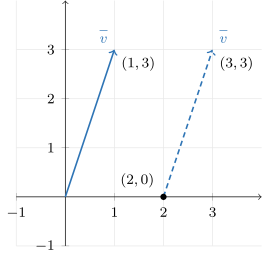
Draw the vector
on coordinate axes, then draw the same vector with its tail at .
ShowHide solution
From the origin, count 1 across and 3 up, and draw the arrow to . From , count the same 1 across and 3 up, which reaches , and draw the second arrow. Both arrows represent , because each travels 1 across and 3 up.
Example 4
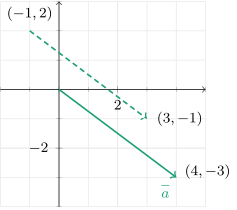
An arrow drawn on coordinate axes runs from its tail at to its tip at . Write the vector it represents as a column, then draw the same vector with its tail at the origin.
ShowHide solution
Count the travel from the tail to the tip.
Across, the arrow travels
and up, it travels
that is, 3 down. The arrow represents
From the origin, count 4 across and 3 down, and draw the arrow to . In the figure, the dashed arrow is the given one and the solid arrow is the same vector drawn from the origin.
Next: 3. Length of a VectorLesson map
3. Length of a Vector
Objective. Given a vector, compute its length (magnitude).
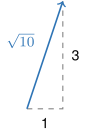
Drawing from the origin puts a right triangle under the arrow, with legs of 1 and 3 and the arrow itself as the hypotenuse. By the Pythagorean theorem the hypotenuse has length , the square root of the sum of the squared components.
In three dimensions the theorem applies twice and gives , and the same pattern gives the length in every dimension. Take a vector of dimension .
Definition 3 (Length (magnitude)).
The length (or magnitude) of a vector with components is the number written and defined by
A length is never negative, because the square root sign always means the nonnegative square root.
Example 5
Find the length of the vector
ShowHide solution
By the definition of length, the length of is the square root of the sum of its squared components. Substitute the components and into the formula for the length:
Example 6
Find the length of the vector
ShowHide solution
Square the four components, add them, and take the square root:
Example 7
A drone climbs from its launch point to a point 30 meters east, 40 meters north, and 120 meters up. Its displacement is
Find the straight-line distance from the launch point to the drone.
ShowHide solution
The straight-line distance is the length of the displacement vector:
The drone is 130 meters from its launch point. The length carries the units of the components, here meters.
Next: 4. Vector Arithmetic by HandLesson map
4. Vector Arithmetic by Hand
Objective. Perform vector addition, subtraction, and scalar multiplication by hand.
Take two vectors of dimension , and , and a scalar .
Definition 4 (Vector addition).
The result of vector addition, for two vectors with the same number of components, is the vector whose components are the sums of the matching components:
The vectors and have no sum, because the definition requires the same number of components: the third component 3 has no partner.
Definition 5 (Vector subtraction).
The result of vector subtraction, for two vectors with the same number of components, is the vector whose components are the differences of the matching components:
The vectors and have no difference, because the definition of vector subtraction also requires the same number of components.
Definition 6 (Scalar multiplication).
The result of scalar multiplication, for a scalar and a vector , is the vector whose components are the components of , each multiplied by :
Scalar multiplication places no condition on the dimension of the vector. The expression is not a scalar multiplication, because the definition multiplies a vector by a scalar, and neither factor is a scalar.
Scalar multiplication in a picture. Multiplying by scales the length by : . The sign and the size of give three cases. Each panel shows in blue and in a second color, with an aircraft’s velocity in hundreds of knots.
Scalar larger than 1
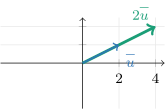
With , the vector points the same way and is twice as long. The aircraft keeps its heading at twice the speed.
Scalar between 0 and 1
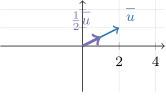
With , the vector points the same way and is half as long. The aircraft keeps its heading at half the speed.
Negative scalar
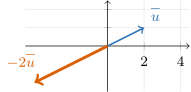
With , the vector points the opposite way and is times as long. The aircraft flies the reverse heading at twice the speed.
Two scalars fall between these cases. With , the vector equals . With , every component of is 0. The product has length 0 and draws as a single point. The vector means the scalar multiple .
Example 8
For
find , , and .
ShowHide solution
Add the matching components to find the sum, by the definition of vector addition:
Subtract the matching components to find the difference:
Multiply each component of by 2 and subtract the matching component of :
Example 9
For
find , , and , with the length of each.
ShowHide solution
By the definition of scalar multiplication, multiply each component of by the scalar. Then take the length of the result:
Because , each length is times the length of , and only points the opposite way.
Example 10
Work each part by hand.
- (a)
An aircraft flies with velocity through air that moves with the wind velocity . Both are in knots, with east first and north second. The aircraft’s velocity over the ground is the sum. Find it for
- (b)
Two drones sit at the positions and , in meters east, north, and up from the launch point. The displacement from the first drone to the second is . Find it for
ShowHide solution
(a) Both vectors have two components. Add the matching components:
Over the ground, the aircraft moves 280 knots east and 40 knots north.
(b) Both positions have three components. Subtract the matching components to find the displacement:
From the first drone, the second sits 20 meters west, 20 meters north, and 20 meters lower.
Example 11
Find for
ShowHide solution
The vectors and have no sum, because has dimension 2, has dimension 3, and the definition of vector addition requires the same number of components.
Next: 5. Drawing Sums and DifferencesLesson map
5. Drawing Sums and Differences
Objective. Graphically represent the sum or difference of two or more 2-D vectors by hand.
A sum computed componentwise can also be drawn tip to tail.
- Draw the first vector from the origin.
- Redraw the second vector with its tail on the tip of the first, keeping its direction and its length.
- Draw the sum from the origin to the tip of the second arrow.
- Check the drawn tip against the componentwise answer.
For two vectors and , the recipe draws first and second. The other order draws from the origin first and tip to tail second. The two orders end at the same tip, because for every two vectors of the same dimension: matching components add the same way in either order, as in .
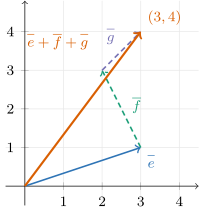
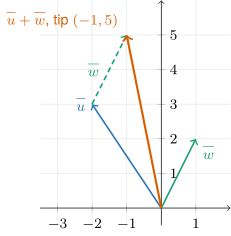
When neither nor is a scalar multiple of the other, the four arrows form a parallelogram, and the two constructions trace its opposite sides. The figure draws both orders for and ; the dashed arrows are the redrawn copies. Both orders end at , the tip of the orange arrow .
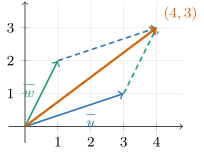
The resultant is the single vector equal to the sum of two or more vectors. With the vectors placed tip to tail, the resultant is the arrow from the tail of the first vector to the tip of the last.
Subtraction as addition of the negative. A difference is drawn as a sum:
- Rewrite as .
- Draw as the arrow of with its tip and tail swapped.
- Run the tip-to-tail recipe on and .
A figure with no grid. Run the tip-to-tail recipe on the drawn arrows themselves:
- Leave the first arrow where it is drawn.
- Redraw each next arrow with its tail on the tip of the one before, its length and direction unchanged.
- Draw the resultant from the tail of the first arrow to the tip of the last.
Matching a resultant on a grid. Compute the components of the resultant first, then look for the arrow with those components.
Matching a resultant with no grid. Build the resultant tip to tail on the figure, then look for the arrow with the same length and direction. If no arrow in a given figure matches the resultant, then the resultant is not depicted.
Example 12
Represent graphically for
ShowHide solution
Run the tip-to-tail recipe on and .
Draw from the origin to and from the origin to . Redraw with its tail on the tip of : 1 across and 2 up from reaches . Draw the sum from the origin to . As a check, the tip matches the componentwise sum
In the figure, the dashed green arrow is redrawn, and the orange arrow is the sum.
Example 13
Represent graphically for
ShowHide solution
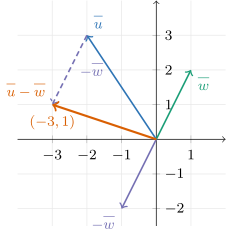
Rewrite the difference as , with .
Draw from the origin to , and and from the origin. Redraw with its tail on the tip of : 1 left and 2 down from reaches . Draw the difference from the origin to . As a check, the tip matches the componentwise difference
Example 14
Represent graphically for
ShowHide solution
Run the tip-to-tail recipe with three arrows.
Draw from the origin to . Redraw with its tail at : 1 left and 2 up reaches . Redraw with its tail at : 1 across and 1 up reaches . By the definition of the resultant, it runs from the tail of the first vector, the origin, to the tip of the last, . As a check, the tip matches the componentwise sum